Showing posts with label branding. Show all posts

Monday, June 20, 2016

Partner Showcase - Seattle Shakespeare Company

When you think of Shakespeare, you probably don't think of mobile apps.  But Seattle Shakespeare Company does.  For the past two years, they have used their mobile app to connect contemporary audiences with the power and vibrancy of Shakespeare and other classical playwrights.

We recently spoke with Communications Director Jeff Fickes to find out what prompted Seattle Shakespeare Company to pursue their mobile engagement strategy.

Jeff Fickes
Why did you decide to offer a mobile app for your patrons?
When mobile apps first appeared in the marketplace, I knew that I wanted Seattle Shakespeare Company to have one. We had meetings did some research, and then saw that the development was going to be out of our reach since we’re a relatively small company.

But I kept dreaming. I had been doing a lot of reading about the direction of consumer trends and everything I read pointed me in the direction of optimizing for mobile usage. We redesigned our website to be mobile responsive and optimized our email campaigns to be read on mobile devices. I still kept thinking about a mobile app.

Click on image for a closer look.
We’re a theatre company that performs in three different indoor venues, 13 different outdoor venues, and has a tour that performs all over the state. We are a mobile theatre company. I wanted us to be easily accessed where ever our patrons are and to be able to communicate with them whether they’re in a theatre, seeing a park show, or a student seeing Shakespeare for the first time with one of our tours.

Why did you choose InstantEncore’s mobile app solution?
I actually stumbled upon InstantEncore. I was searching around in the App Store to see what other theatre companies were doing in terms of mobile apps, and saw that some of the larger theatre organizations across the country (Guthrie Theatre, Arena Stage, and Berkeley Rep) were using InstantEncore. I immediately requested a demo and got very excited about the prospect of making a long term goal happen.

InstantEncore offers a great deal of flexibility and allows you to tailor the app to your own needs. It worked with our ticketing system and the pricing was within our budget. I didn’t need a lot of convincing. We started devising a plan for how we wanted to use the app and got it set up within a week or so after signing up.

Seattle Shakespeare Company uses
their app's At-The-Venue feature
to engage audiences at performances.
Click on image for a closer look.
How have you promoted your mobile app to your patrons?
We’ve promoted the app through lobby signs, curtain speeches, our website, email notices and program ads. We’ll most likely do a small facebook digital ad campaign in conjunction with our upcoming outdoor shows this summer, as we’ve found it to be very useful for locating which park show is performing where - since the shows are in a different location practically each night.

What are the main benefits of your mobile app for your patrons?
Aside from being able to engage with patrons on a device that many people have a personal attachment to, I believe it’s worked well for us from a branding standpoint. We were one of the first theatre companies in Seattle to have a mobile app.

Just the fact that a theatre company of our size who focuses on classical plays has an app says something about the company. It sort of shakes off the perceived stodginess of classical plays and gives people a digital interaction in addition to the stage experience.

I believe that patrons start to experience the play well before they enter theatre. They’re conceiving of it in their mind through the advertising images and words written about it. If they’re engaging with the play (learning about it and the company) through a mobile device and can do it where ever they may be (on the bus, waiting in line at the store, at home on the couch) we become much more a part of their lives. The perception of the work on stage takes on a different relevance because we’ve engaged with them on their terms, on their time. The art can seem more relevant to a contemporary world because the engagement was digital.

SSC uses push notifications to
send contextually relevant messages
to patrons. Click on image for a
closer look.
Which feature do you like best? Why?
I love the At-The-Venue feature. I believe that if a patron feels informed about the show they’re about to see, that their experience of it is better. We include video welcome messages, things to know, directors notes, cast bios as well as special offers to entice them to buy in our shop or make a purchase of their next ticket.

We’ve also run some very unique sales promotions (including a one day $12 ticket promotion in honor of the Seahawks being in the Super Bowl) that utilized the push notifications and custom tabs.

What’s the feedback on the app been like from your patrons?
We’ve gotten good feedback and have seen the app consistently utilized, especially on show days. I think that adoption has been slow and most of the people regularly using are “super fans.”

What has customer support been like?
Customer support has been great. I like that the product continues to be developed with new features added.

Thursday, June 2, 2016

Maximize Convenience and Customization for Your App's Home Screen with Cards

The Home screen is crucial for your mobile app's success. It's the first thing people see when they use the app. Making a good first impression sets the tone for their entire experience.

If they see old information or a blank screen, then they might assume the app has nothing relevant to them and delete it.

So how can you avoid this without spending too much time doing maintenance? With the newest option in your toolkit - the Cards home screen!

Cards combines the convenience of the What's New home screen's automatically updated content feed with the endless customization options of the Slideshow home screen.

Activating the Cards Home Screen

Turning it on is easy.  Go to Mobile >> Tabs, and look for "Home: Cards" in the Type column.  Enable the Display checkbox for that item.

Activate and manage the Cards option in the Tabs area.
Click on image for a closer look.
To manage your Cards tab, click on the link in the Text column.

Once the tab is set up, users will be able to scroll through a list of all available Cards that link through to your content.


Header Image

Examples of Header Images.
Click on image for a closer look.
The first feature of your new Cards tab is an optional Header Image.  This banner image can be whatever you like. Just make sure it isn't too tall that it eats up all of a phone's real estate. We recommend a 3:1 width to height ratio.

Some popular examples are:
  • A photo of your ensemble, performance venue, or building exterior
  • The logo and branding of your organization.
  • A major sponsor (Note: It will not link to their website)


Content Cards

Without having to do any extra work, this tab will automatically create Cards for your active At-The-Venue Experiences and for your upcoming Event listings.  There will also be Cards that highlight the most recent Music, Video, or Buzz content. If there is no content for any of these, then that Card won't display. Everything is taken care of for you.

Access specific content or view all.
Click on image for a closer look.


However, you still have the power to do more.  You can drag-and-drop them to rearrange their order. Managing them lets you customize their label or decide if you wish to hide it. You can even add Custom Cards to supplement what your new home screen has to offer.


Custom Cards

Custom Cards in action.
Click on image for a closer look.
Custom Cards are very similar to Slideshow Slides, just smaller (and in some ways better!). Instead of a full screen graphic, all you need is another 3:1 banner.

You will be able to add a Headline and Description to give your users an idea of what content they will access through the Card.  This should just be a short paragraph at most. You will want to have multiple Cards visible on the screen at the same time to retain the Cards feel.

The Action Text should be a short phrase that tells users what you want them to do. "Tap Here", "Read More", "Learn", etc.  Then, provide an In-App URL to another tab or content item, or even an external URL. The entire Custom Card will act as one large, easy-to-tap button that links the user to that content.

This gives you the power to do whatever you want. Link to another Custom Tab with parking information, highlight a specific Music Album, link to your most popular Social Media platform, or highlight a Season Sponsor. 

One other big change from the Slideshow Slides is that in addition to being scheduled, you can leave the date fields blank to have the card always display.

Additional Resources

Video: Managing the Cards Home Screen
Video: Adding Custom Cards to Your App's Home Screen
Partner Example: Pittsburgh Symphony Orchestra (for best results, view on a mobile device)

Thursday, January 22, 2015

Using Your App's Offers Tab to Drive Revenue, Encourage Participation, and More

At-The-Event's Offers tab is a powerful tool help drive revenue in creative ways.  From discounts to merchandise to upgrades, the Offers tab can present deals to your audience which are specifically relevant to that day's event.

Lets look at a few general categories of Offers:

Discounts


Discounts are perhaps the most straight forward Offer you can provide.  These include a percentage-based or fixed amount reduction on ticket sales, gift shop merchandise, concession items, etc.  You might even explore partnering with a local restaurant to provide discounts on meals to help drive customers to both businesses.

Alabama Dance Festival: 15% off Tickets


Detroit Symphony: 10% off Food & 10% off Gifts


Berkeley Rep: Free cookie with drink purchase


Pittsburgh Symphony Orchestra: Dinner and a Show


Merchandise


Let your audience know about new recordings, apparel, or other fun souvenirs that they can purchase.

Bach Collegium San Diego: New CD Release


SFJAZZ: 'A Love Supreme' 50th Anniversary Shirts


Activities


You can also use the Offers tab to make your audience aware of fun activities such as parties, receptions, or artist signings.

UMKC: Pre-concert reception


SFJAZZ: 'A Love Supreme: The Story of John Coltrane's Signature Album' Book signing


Special Access


The Offers tab can be used in creative ways such as giving your audience access to special opportunities exclusively through the app.  Making tickets available for pre-sale, upgrading your seat, turning a single ticket into a season subscription, and music downloads are just a few of the endless possibilities.

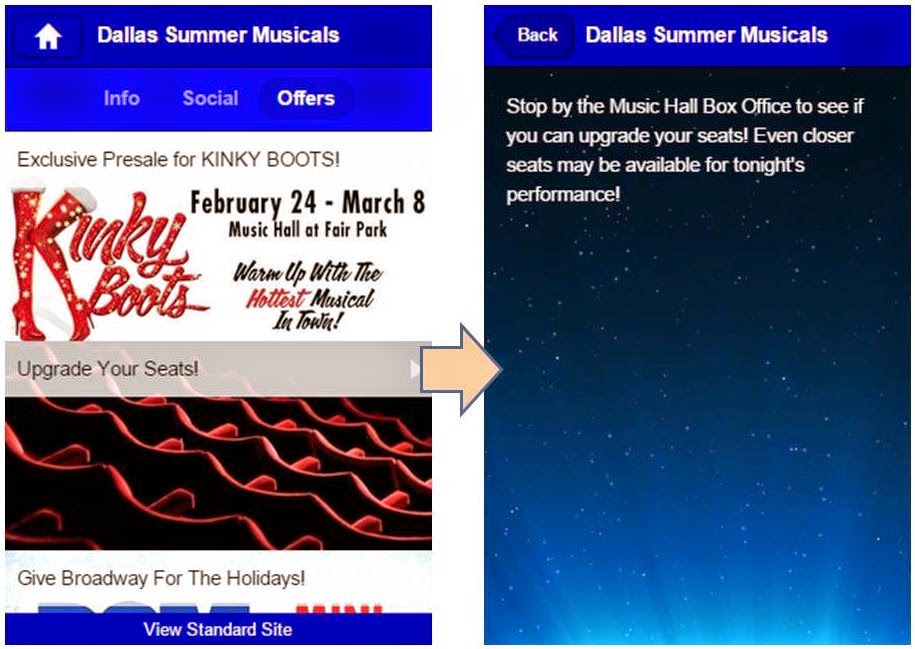
Dallas Summer Musicals: Pre-sale Tickets & Seat Upgrades


Indianapolis Chamber Orchestra: Turn your Ticket into a Subscription


CYSO: Music Download


Enter to Win!


Use the Offers area to promote competitions,  raffles, or other sweepstakes that audience members can enter by posting in the Social tab or filling out a form linked as a custom action in the Info tab.

The School of Theatre at Florida State University: Win Free Tickets


Friday, October 31, 2014

Tips for Promoting Your Mobile App, Part 1: Encouraging Downloads When Patrons Are Off-Site

One of the questions our partners frequently ask is, "How should we promote our app?"  To help you answer that question, we decided to provide you with some tips.  However, there is so much information that we had to break it into two separate posts.

We'll start with tips for how to promote your app when the patrons are not at one of your events.

8 Tips for promoting downloads when the audience is not at your event or performance


1.  Encourage mobile users who visit your website to download your app.  Makes sense right?  They are already on their mobile devices, so you should take the opportunity to direct them to your app.  Here are two ways you can do this:
Silk Road Rising uses the
mobile redirect script to
send mobile users visiting
their website to the mobile
web version of their app.

  • If you do not have a mobile responsive website or separate mobile site, be sure to use InstantEncore's mobile redirect script. (click here for how-to video)
    • This will redirect mobile users from your standard website to the mobile web version of your app.
    • It will also detect if the mobile user is on an Apple or Android device and present them with a prompt at the top of the screen to download your app on their device.
  • If you do have a mobile responsive site or separate mobile site, feature a notice for your mobile app on the home screen.
    • Provide a short message highlighting what additional features they will have access to by downloading the app.
    • Add the icon for your app to the screen.
    • Link the icon to your app's Smart App Download URL.
    • Instruct the user to tap on the icon to download the app.

2.  Encourage desktop/laptop users who visit your website to download your app.  This one might not be as obvious as the first one.  With the rapid rise of smartphone and tablet users, the probability is strong that people who visit your website on their desktop and laptop computers are also mobile users.  So why not encourage them to download your app? Here are two suggestions:
  • Add mobile app download buttons to your home screen.  
  • Austin Symphony Orchestra uses buttons on their website to
    encourage visitors to download their mobile app.
    • Add a button for both your Apple mobile app and your Android app.
    • Buttons for:  Android  |  Apple
    • Link the button to its appropriate URL.
    • To find the web link for each of your apps:
      • Go to www.instantencore.com
      • At the top where it says "Search or Redeem," enter the name for you or your organization.
      • "Search or Redeem" field on the InstantEncore site.
      • Find and click on your account name to go to your InstantEncore profile.
      • Clicking on the image for your mobile app gives you a drop-down menu with links to your Android and Apple URLs.
Links to Seattle Shakespeare Company's Android and Apple
apps in their InstantEncore profile.

3.  Create a video to spotlight your app.  While this may sound difficult, it really isn't.
  • Decide which features you want to mention and which ones you want to show in use.
  • Write out a script for the video.
  • Consider recruiting one of your artists to be video spokesperson for the app.
  • Practice going through the script while interacting with your device.  
  • Get a sense of how long it takes you to go through the script.  You should be able to highlight the more exciting features in a 1 to 2 minute video.
  • For example: here's an informative and funny video for the 2011 YouTube Symphony mobile app featuring flutist Nina Perlove:

  • At the end of your video, include the Smart App Download URL as the closing image.
  • Upload the video to YouTube - be sure to put the Smart App Download URL in the video's description.
  • Post it everywhere -- embed the video on your website or blog; share it on social media; link to it in email newsletters; etc.

4.  Feature the app prominently in your email communications.  
  • Spotlight your app in e-newsletters, subscriber emails, pre-show emails to ticket holders, etc.

    Email example from Curtis Institute of Music.
  • Be sure to mention your mobile app in confirmation emails for online ticket sales and/or reservations.
  • Include a brief description of your app's features as well as a link to the Smart App Download URL.

5.  Spotlight your app on the back of printed tickets and/or ticket envelopes.
  • Include the app logo and a brief description of the app's value.
  • Highlight the Smart App Download URL.
  • Add a QR Code linked to the Smart App Download URL. (click here for how-to video)

6.  Highlight your app on printed promotional pieces for your events and season.
  • Feature your mobile app and its features in your season brochure.
  • Mention your mobile app and its value in your event postcards, posters, and flyers.
  • Include the app logo, the Smart App Download URL, and/or QR Code.

7.  Alert your social media followers to your app.
  • On a regular basis, post screenshots from your app to highlight new content available in your app.
  • Include a link to the Smart App Download URL. 

8.  Use your App Store Description to highlight its features.  It's not enough to simply send patrons to your app's URL on iTunes or Google Play.  Once they are there, you need to communicate why they should download the app.


In Part 2 of this blog series, we will focus on tips for encouraging app downloads when your patrons are attending your event or performance.

Questions?  Contact us at support@instantencore.com. 

Monday, October 28, 2013

New Style Options for Your Mobile App

There are two new features in the InstantEncore mobile suite which further expand your ability to control the look and feel of your mobile app.

Light and Dark Themes

For the past three years, the InstantEncore mobile suite has had a single streamlined theme with white text over your custom background image or color.  Given the constraint of white text, this style theme was intended to include a darker background image or color to provide strong contrast to the text.  Correspondingly, this original theme is known as the "dark" theme.


One of the new features in the mobile suite is the addition of a "light" theme, featuring black text and intended to be combined with a lighter (or even white) background image or color.


To alter your mobile app's theme, go to Mobile >> Style in the control panel. The system defaults to the original dark theme.  You may change the theme by using the drop-down tool to select "Light."

Custom CSS Tool

The other new feature added to the mobile suite is a Custom CSS tool which allows you to set style and formatting preferences for custom content tabs you create for your mobile app.  

By creating custom tabs in the mobile suite, you are able to create content areas in your mobile app to meet the specific needs of your patrons. CSS (Cascading Style Sheets) allow you to change the style or presentation of HTML code in these custom tabs.

The CSS Tool is an advanced area of the control panel and should only be edited by someone with previous CSS and HTML experience.  If you do not have this previous experience, then please consult a web designer before making any changes to this area.


To access the CSS Tool, go to Mobile >> Style and select "Manage custom CSS styles."


If you have any questions about either of these new features, or any other elements in the control panel, please contact us at support@instantencore.com. 

Sunday, April 14, 2013

New Series of Tutorial Videos for Making the Most of Your Mobile App

With the release of version 2.0 of the InstantEncore mobile suite, we have created a series of short, tutorial videos to guide you through particular tasks and content areas in the control panel.  You may view all of the videos as a YouTube playlist or individually, as follows:

The Basics

Thursday, December 27, 2012

InstantEncore's Mobile Class of 2012

Congratulations and thank you to all of the artists and arts organizations who launched apps with InstantEncore's mobile suite in 2012! Below is a slideshow spotlighting our Mobile Class of 2012 from individual musicians, ensembles, orchestras, theatres, opera companies, ballet companies, ticket offices, and more.
InstantEncore's Mobile Class of 2012 from InstantEncore. Maximize for best viewing.

Thank you again to all of our partners for making 2012 such a great year! We wish everyone a happy new year and look forward to working with you in 2013.

Monday, March 12, 2012

Branding Your Mobile App with Graphics

According to the American Marketing Association, a brand is "a name, term, sign, symbol or design, or a combination of them intended to identify the goods and services of one seller or group of sellers and to differentiate them from those of other sellers."  So how are performing artists and arts organizations using graphic elements within their mobile apps to identify and differentiate themselves from other artists and arts organizations?

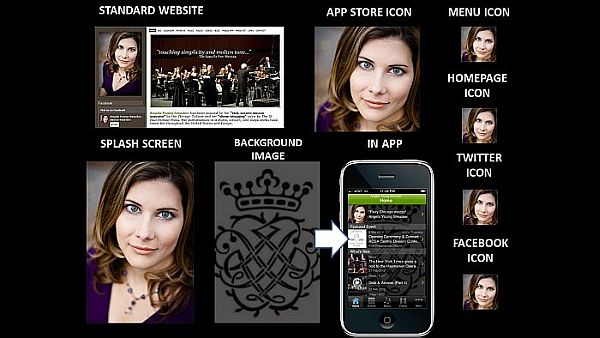
Mezzo-soprano Angela Young Smucker IS her brand.


VISAGE: For individual artists and ensembles, they are the brand.  Correspondingly, the brand is typically connected directly to their visage.  In the example above, mezzo-soprano Angela Young Smucker uses her headshot as a primary tool for building her brand recognition.

You'll notice that she uses a singular image as a graphical branding tool - for every icon, for every platform.  The constant and consistent use of this image provides for a strong fortification of her visual brand online and on mobile devices.

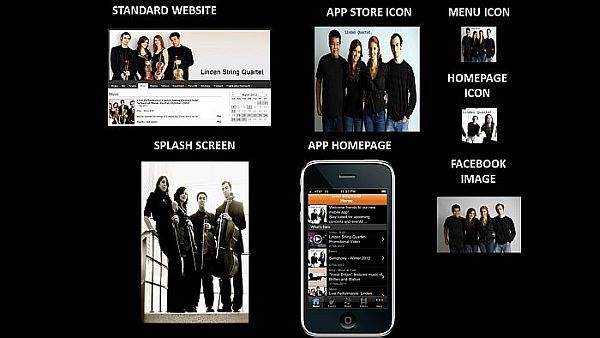
Linden String Quartet uses various images of the group members to strengthen their brand.


The use of multiple visage-focused graphics can also reinforce an artist or ensemble's visual brand.  In the example above, Linden String Quartet uses multiple images of the quartet members to fortify their brand.  In some of the images, they hold their instruments which plays more strongly on the musical nature of the brand.  Other images feature the ensemble in jeans and t-shirts which highlights their accessibility.

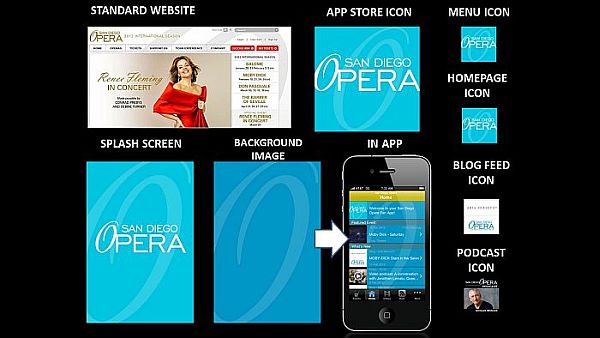
San Diego Opera builds its visual brand around the typographical design for the "O" in opera. 


LOGO:  Perhaps, the most common visual branding element for organizations is their logo, which may be an image, text, or a combination of the two.  For example, San Diego Opera has a primarily textual logo with the sole graphical departure being the "O" in opera, which has a different slant and font than the rest of the text.  While they often use the entire logo to brand the organization, a predominant emphasis is placed on the "O" for building brand recognition.  Even in the smaller icons for their mobile app, the signature "O" is the piece of the logo that remains the most recognizable.

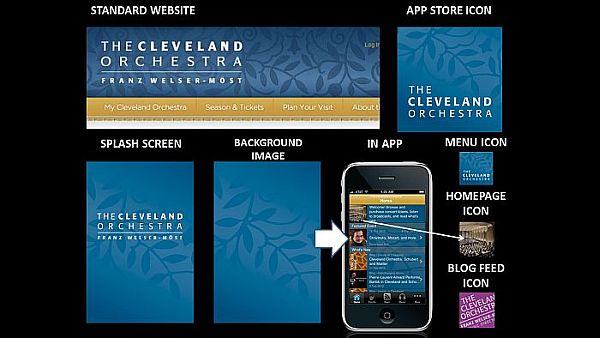
The Cleveland Orchestra uses a seemingly unrelated graphical element -- branches with leaves --
as the primary tool for visually branding the organization within its mobile app.


Sometimes the logo shows a direct relationship to the organization, as in the case of the San Diego Opera.  Other times, the logo pushes the viewer to make their own connections between the graphic and the organization.  If we look at The Cleveland Orchestra, we can see that they consistently use a silhouetted branch pattern in their visual branding.  As there is nothing particular about this branch pattern that connects directly to orchestral music or the city of Cleveland, viewers must create the relationship for themselves.  Interestingly enough, the consistent and repeated use of the graphic insists to the viewer that there IS a connection -- we just have to figure out what it is.

Okay, so what about their Homepage Icon?  This icon appears in the Welcome message area at the top of the Home page.  It also serves as the default icon for any content in the mobile which does not have an image associated with it.  In this case, The Cleveland Orchestra was already using their graphic and color (see next section) in the Background Image for the app - so they needed to use another image as the Home page so that the icon did not get lost.  They decided to use an image of the stage from the audience's point-of-view.  This is a great way of subtly reinforcing the app user's relationship to a live performance's audience.  Bravo!


COLOR:  As noted above The Cleveland Orchestra carries the colors established on its standard website into its mobile app as a branding element.  Another example of how color may be used for branding within the mobile app is Pacific Symphony.  Let's analyze the collage above from top left across and down to bottom right.

Pacific Symphony starts pulling color from their standard website into the header for their Tumblr blog along with the graphical and textual elements of their logo.  Then, they pull the color into a gradiated background for the app store icon which also features the logo's text in white as well as a silhouetted version of the logo's graphic.  This reappears in both the Menu Icon and the Homepage Icon.

They choose a lighter version of the background color and graphic silhouette for the app's Splash Screen, then they exchange the background color for a complimentary one in the Background Image.  Why?  With the Homepage Icon pulling the same color and graphic presentation as the App Store Icon and Menu Icon, they need a strong contrasting color that would allow them to continue to use the graphic element within the Background Image without it being too much for the eye.  It also provided them with another color that could be used in Blog Feed Icon to further differentiate where the content in the app is coming from while maintaining the organization's visual brand.

So as you build your online and mobile presence, consider your visual brand every step of the way.   What must stay consistent and where can you benefit from variation?  If you can master that, then your fans will always recognize your brand - wherever they may see it.